Two in-depth articles recently published on souverain.ovh deserve careful reading. The first is a thorough hands-on test of Twake Workplace, LINAGORA's open source sovereign collaborative suite. The second goes much further: a strategic reflection on what European suites still lack to genuinely compete with Google Workspace and Microsoft 365—and the role Open Buro could play.
These are not sponsored posts. They represent the demanding perspective of a user who tests, compares, documents, and challenges. This is exactly what the sovereign ecosystem needs to move forward.
The Diagnosis: It's Not About Individual Tools
The reviewer articulates with remarkable clarity what many feel without always being able to express. The problem with European sovereign suites is not the quality of individual tools. It is the absence of workflow chaining:
Email → synchronized contact → calendar with availability → video link → join in one click. This is not a feature. It is a workflow. And it is precisely this workflow that makes Google and Microsoft so hard to leave.
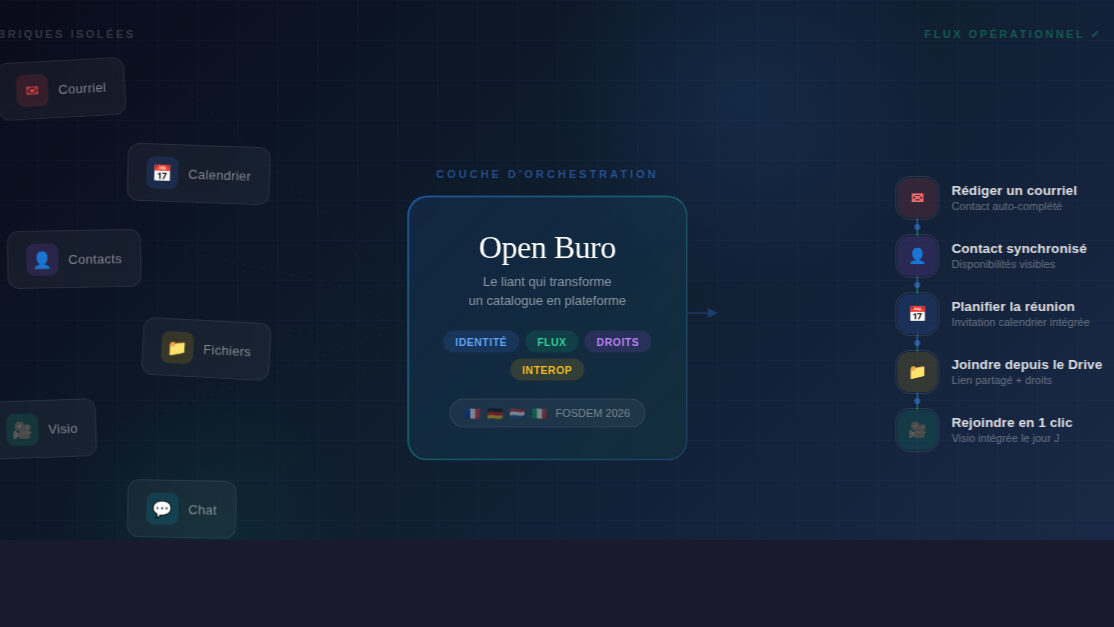
Microsoft doesn't win because Word is irreplaceable. It wins because the entire ecosystem is interconnected, fluid, and seamless. Open source tools, despite their quality, remain isolated islands.
"Don't Copy Gmail": A Shared Conviction
The reviewer argues against reinventing the user experience from scratch. LINAGORA agrees. The webmail is the entry point. It is the Trojan horse of adoption. Ignoring this means ignoring 20 years of web history. But "don't copy Gmail" doesn't mean ignoring why Gmail worked—it means doing better, with our own values.
The reviewer also notes a turning point: UX is no longer a weakness for sovereign suites. At LINAGORA, this evolution is no accident. It is the result of deliberate investment in design, ergonomics, and user research. That independent observers notice this shift is the best validation possible.
Open Buro: The Missing Vision
The reviewer dedicates a significant portion of his analysis to Open Buro, the project jointly initiated by DINUM and LINAGORA. And he identifies the essential point:
The Platform Problem
The building blocks exist. But they don't yet form a platform. Microsoft is not hard to leave because Word is irreplaceable—it is hard to leave because everything is interlocked, fluid, seamless. Open Buro aims to fix exactly this: a shared orchestration standard, so that independent services assemble and communicate properly, under open governance.
The reviewer references the first Open Buro working group, formed at FOSDEM with Samuel Paccoud and Benjamin Andre. He also cites Henri Verdier praising how the DINUM team built European cooperation with Germany, the Netherlands, and soon Italy—moving beyond the reflex of "let's pick one solution: mine."
This is precisely the dynamic Open Buro is part of.
The Trust Challenge
The reviewer concludes with a plea for what he calls "the trust project": building a narrative, simplifying migration, demonstrating through proof. He proposes concrete actions: migration kits, public demos, ambassadors, enterprise adoption proof points, self-hosting packages, multilingual communication.
Migration is a psychological act before it is a technical one. We must reassure those who doubt, those who lack time, those who fear losing their habits.
LINAGORA has been building open source solutions for European institutions and French ministries for over 25 years. Large-scale migrations, compliance requirements, resistance to change—this is daily reality. Mass adoption will be built step by step, through trust, through a credible narrative and concrete progress. Not through a big bang.
We Are Closer Than Ever
The reviewer writes: "We are close. Closer than we have ever been."
And: "2026 is the year of digital sovereignty, not 2027."
We share this urgency and this clear-eyed optimism. The transition cannot be decreed. It must be built. Brick by brick, workflow by workflow, trust by trust.
Back to all news